
When Did The Media Room Become An Essential Part Of Our Homes?
We do not always think of it that way, but function often shapes the form of every room in our house, and the most elegant interior designs and bespoke furniture put purpose at the forefront.
Whilst it is easy to determine how form follows function for a bathroom, a kitchen or a bedroom, this is also true for a dining room, a study or even a living room, particularly as so many additional living areas are being turned into media rooms.
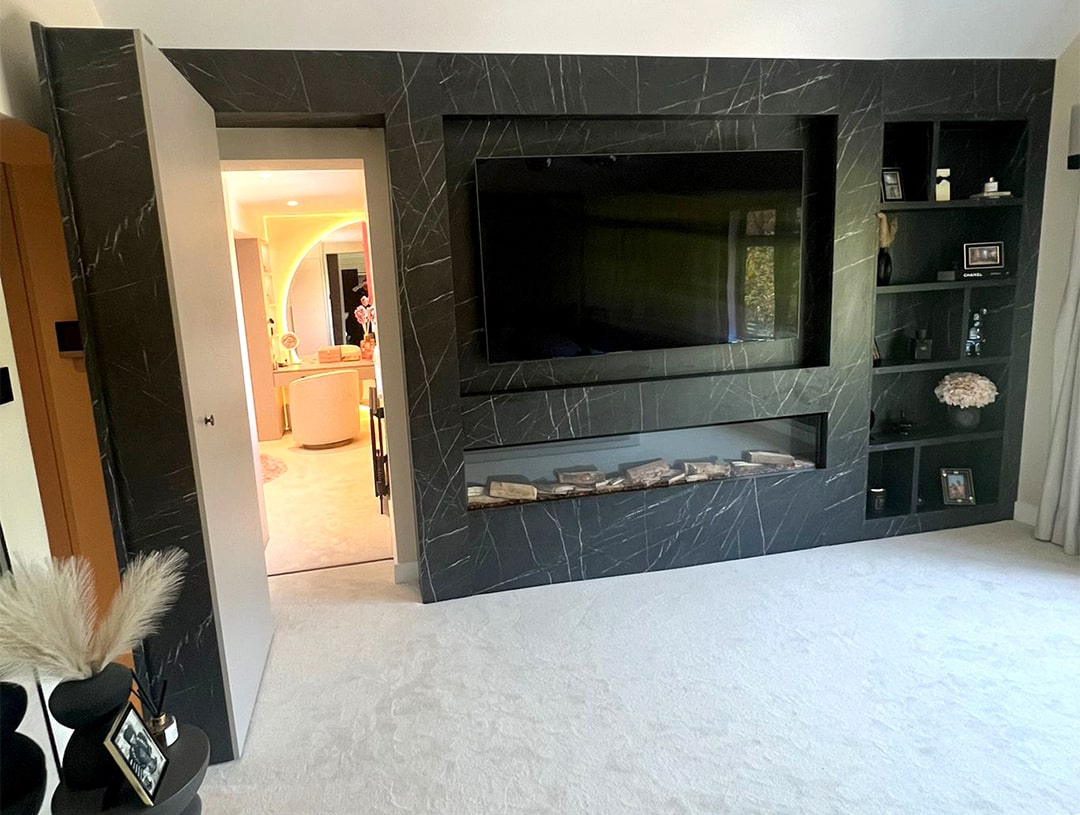
What makes a media room so special is that it is a personal imprint on a house; rather than simply being another type of room which happens to contain a television or media centre, a media room and its bespoke wall units are based around your own needs and viewing habits.
Some media rooms are designed to shape a room like a home cinema, whilst others are designed with versatility, cable management and video games in mind. Many are somewhere in between.
However, to understand how media rooms are designed and shaped today, it is worth taking a look at how the media room or home cinema has been shaped by both the technological and cultural evolution of watching films and TV shows at home.
How Old Is The Media Room?
For almost as long as the cinema has existed, there has been a desire to take that cinematic experience home with you. Rather incredibly, the first steps towards a home cinema began barely half a decade after the invention of the feature film.
The first ever home cinema technology was the Edison Home Projecting Kinetoscope, an attempt to expand the peep show projector into a communal experience.
Whilst it could project a full motion picture without changing reels, something that would not be the case in full-sized cinemas for decades afterwards, it was silent, low quality, hard to use and very expensive.
It sold terribly, not least because it was sold in the same place as Edison phonographs and dealers more comfortable selling music equipment hated having to try and sell it, as well as a fire in West Orange, New Jersey, which destroyed a lot of the Kinetoscope equipment.
In the 1920s, a similar approach using 16mm Kodascope projectors was relatively more successful, but it had the same problem of being expensive to buy and expensive to get films to watch on it.
This meant that the home cinema was largely the preserve of the wealthy, but the principle of comfortable seats, bespoke cabinets storing a projector and film reel, and even primarily using a projector.
When Did Media Rooms Become More Available?
Following the Second World War, home cinemas and projection rooms became slightly more available, but they were realistically still very expensive, often limited to the parlours of the upper middle class.
Smaller projectors were gradually getting cheaper, but they were still primarily used for showing self-shot footage of celebrations, events and family moments, similar to a static projector or handing out a series of photographs.
The big change came with the rise of the video cassette tape, particularly the VHS format in the late 1970s, which turned the home cinema from an affluent curiosity into a serious consideration.
The first modern media room on record was designed in 1974 by Steve LaFontaine for a furniture store in Louisiana.
This was the first system to take full advantage of furniture solutions and cabinets to incorporate surround sound systems with precisely positioned speakers, as well as modified rear-projection televisions designed to be much bigger than usual.
This was perhaps the first media wall as we know it today, but it would be far from the last.
When Did The Media Room Become An Essential Part Of The Home?
Whilst the 1970s increasingly brought televisions, video players and home electronics into the home and shaped how existing living rooms were designed in order to ensure that the new technology fit both aesthetically and literally, there is perhaps one day when it became clear that the media room was the future.
On 6th June 1982, Chicago, Illinois hosted the Summer Consumer Electronics Show (CES), and alongside a wealth of new technologies and advances on existing kit, Peter Tribeman coordinated a demonstration of what would become the media room of the future.
Combining a high-quality screen, multi-channel surround sound and provisions for both storage and comfort, the three-day demonstration made it clear that the future of the home would need to be adapted for the media room.
It was still a luxurious expense, and up until the late 1990s required rather advanced equipment such as front/rear projection televisions for larger image and often a LaserDisc player to maximise the quality of picture available.
All of this shaped the furniture required; large TVs were particularly heavy and needed robust stands and bespoke furniture built around them, whilst the bulky size of LaserDiscs and their players required wider, larger cabinets than those needed for VHS tapes.
When Did The Media Room Become A Widespread Essential?
Throughout the 20th century, the progression of the media room was increasingly developed toward accessibility, with cabinets, frames and cupboards designed to match the wealth of new audio-visual equipment.
Hi-fi systems and TVs would often help in this regard, often designed with woodgrain panels for easier integration, but the media room was still not necessarily ubiquitous, and televisions would remain relatively small in many homes up until the new millennium.
This would change drastically with the development of flat-screen televisions, which allowed for larger, more affordable screens to be mounted and displayed in a far greater variety of places in a room and essentially established the media wall concept.
Rather than having to work around a bulky television, homeowners could mount a huge flat screen on the wall and design cupboards, shelves, cabinets and furniture around it to fit a growing set of needs,
As well as this, the DVD player, later the Blu-Ray player, allowed for curated collections of films, television shows and other media to be showcased, and led to the development of dedicated shelves and cabinets to display collections.
Inspired to start your project?
Book a free, no-obligation at-home design and quote with our friendly team today.